A Dumb Triton Runtime Error
I have been writing some Triton code recently, and it has been very interesting. I have been writing CUDA C++ for some time, and Triton feels like it makes a lot of things much simpler than CUDA C++ does. Maybe I have not reached the harder parts of Triton yet, but at this point in my journey things have been easier.
Triton, for the uninitiated, is an open-source, Python-based domain-specific language (DSL) and MLIR-based compiler designed for writing high-performance deep learning compute kernels. Coincidentally, I have been working on Tesserae, a DSL with the exact same goal, except that it does not use MLIR—it uses a custom IR called Tirix. This is another reason I am practicing Triton: to get a feel for similar architectures and their performance. It is also interesting to see so many parallels in ideas.
In this post, I will walk you through one Triton kernel I wrote last week, and how a discussion with a fellow triton programmer led me to replace two lines of code with one. That change produced an error that made me curious about how Triton works under the hood. The short version: a scalar pointer and a vector value ended up in the same tt.atomic_rmw operation, and Triton’s IR verifier rejected it before the kernel ever reached a GPU. (The error surfaces as a Python RuntimeError, but it is raised at compile time, hence the title.) Along the way I also made a second, smaller mistake with the other= padding value, which I cover in Step 2. I also tested two ways to make the atomic version valid. Both work, and I explain why I would still prefer the original kernel.
The kernel itself
The kernel we will be looking at is Tiled Triton Row Sum, problem number 344 on TensorTonic, an online LeetCode-like platform for practicing GPU programming. The problem heading already tells us most of what we need: a row sum, performed as a sum reduction across each row in a tiled fashion in Triton.
Conceptually, the answer is easy, and it is a familiar idea from SIMD programming, where a vector register is folded down to a single scalar (a “horizontal” reduction). The interesting part is how Triton expresses it.
Here is the code on my GitHub. TensorTonic automatically creates a repository and adds completed solutions inside it: GitHub (Please dont judge my coding stats I know I have only solved 6 questions up until now :())
Here is the working code (not present in the GitHub)
@triton.jit
def tiled_row_sum_kernel(x_ptr, out_ptr, n_cols, row_stride, col_stride, BLOCK_SIZE: tl.constexpr):
    row_idx = tl.program_id(axis=0)
    row_start_ptr = x_ptr + row_idx * row_stride

    # Running float32 accumulator vector for the tile
    acc = tl.zeros((BLOCK_SIZE,), dtype=tl.float32)

    # Step across the row in tiles of width BLOCK_SIZE
    for col_offset in range(0, n_cols, BLOCK_SIZE):
        col_indices = col_offset + tl.arange(0, BLOCK_SIZE)
        mask = col_indices < n_cols

        ptr = row_start_ptr + col_indices * col_stride
        chunk = tl.load(ptr, mask=mask, other=0.0)

        # Convert to float32 before summation
        acc += chunk.to(tl.float32)

    # Reduce the 1D tile accumulator to a single float32 scalar and write to out[row_idx]
    row_sum = tl.sum(acc, axis=0)
    tl.store(out_ptr + row_idx, row_sum)
For anybody who knows Triton, this is very straightforward to read—in fact, it was marked Medium on TensorTonic, which is pretty ironic. Either way, here is a diagram of the execution to help with both the code and what it does under the hood:
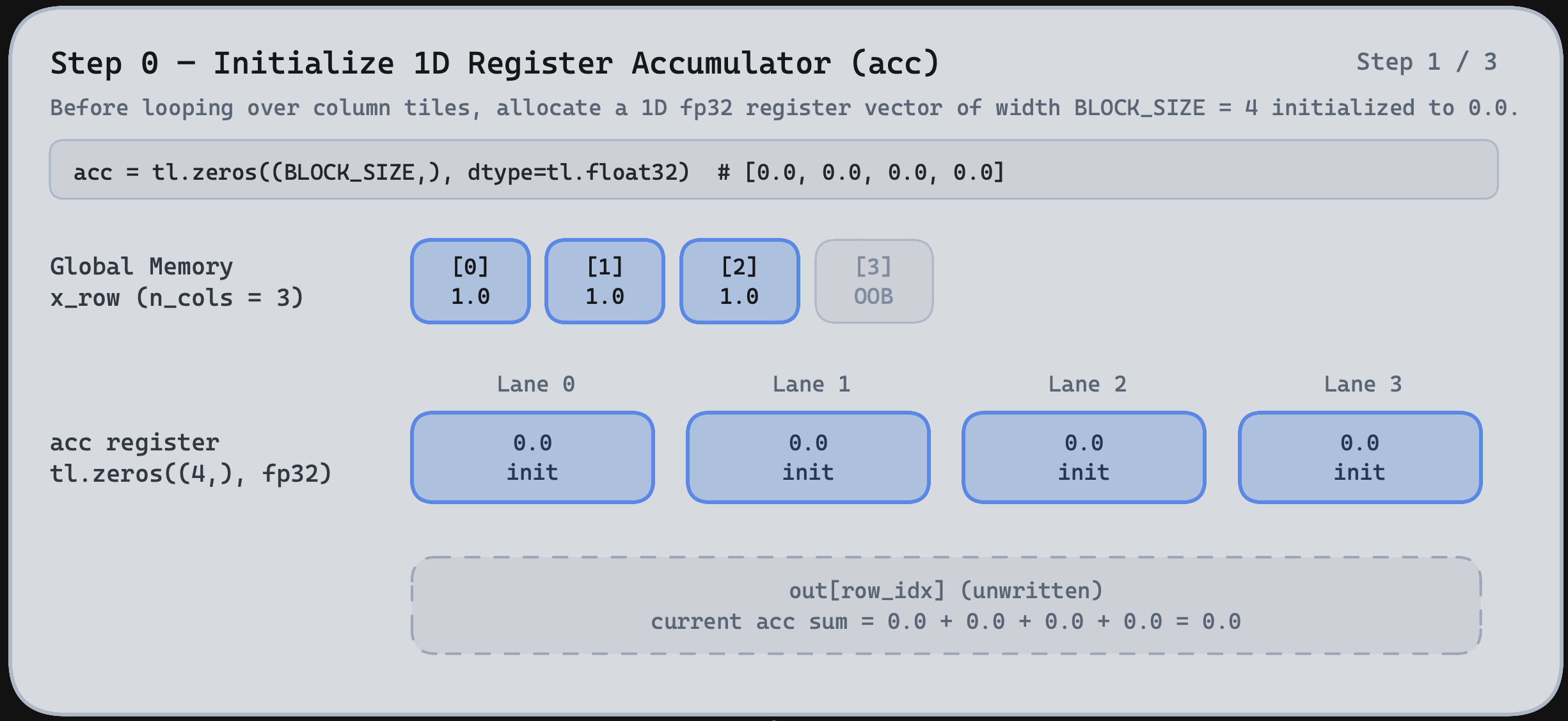 Figure 1: Step 1 — Initializing the 1D accumulator vector in registers (
acc = tl.zeros)
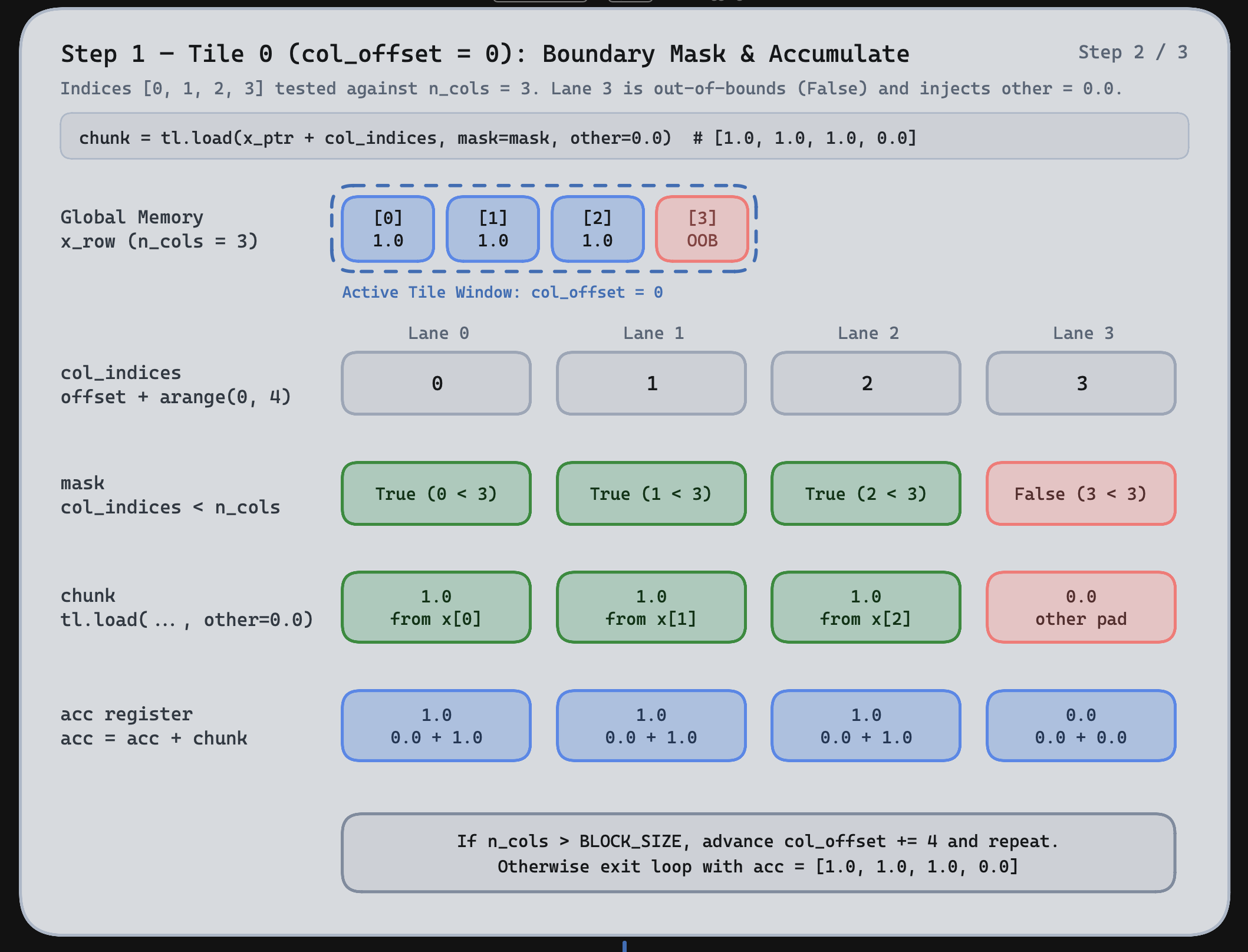 Figure 2: Step 2 — Tile window boundary masking and lane-local vector accumulation
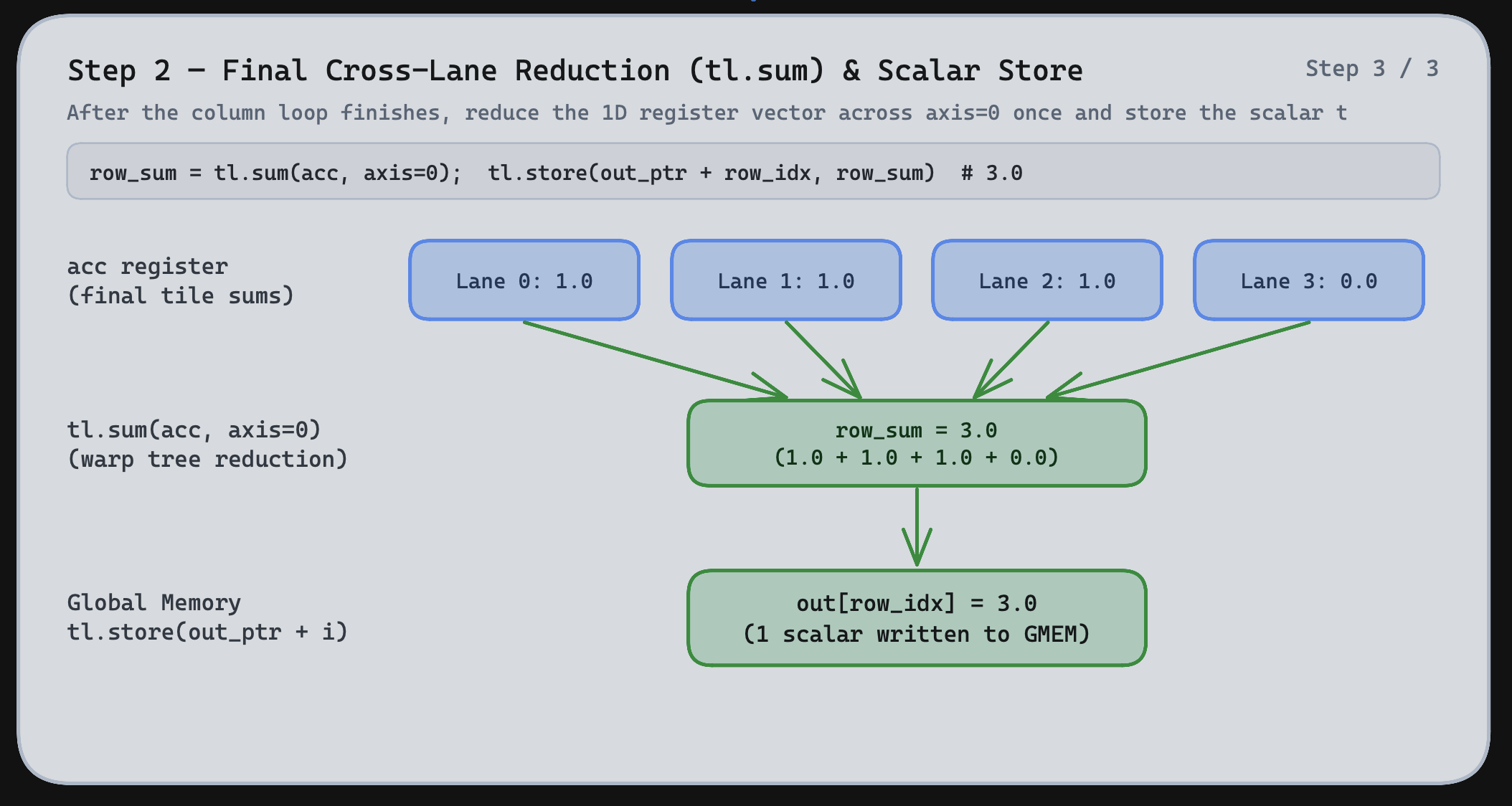 Figure 3: Step 3 — Final cross-lane tree reduction (
tl.sum) and scalar store
We can divide the execution into three steps.
Step 1: Program Grid, Pointers, and Register Initialization
Let us say we have a single row with number of columns or n_cols=3:
x = [1.0, 1.0, 1.0]
In Triton—and in any CUDA programming paradigm, this tensor resides on the device side in Global Memory (HBM/VRAM) after being copied over from the host. To process it in parallel, we index the columns of a tile with col_indices. While “lane” in hardware strictly refers to a thread inside a 32-thread warp, thinking of tl.arange(0, BLOCK_SIZE) as virtual SIMD lanes is the cleanest mental model for Triton. If our tile width is BLOCK_SIZE = 4, our tile has 4 lanes indexed 0 through 3. The first 3 lanes map to valid elements ([0, 1, 2]) and Lane 3 falls out-of-bounds (OOB).
Let’s look at what the kernel takes in as parameters:
x_ptr: A device pointer to the start of the input matrix.out_ptr: A device pointer to the output vector.n_cols: The logical number of columns () in each row.row_strideandcol_stride: The row and column strides, in elements. These determine how far the pointer must move in physical memory to step to the next row or the next column. Passing explicit strides lets the kernel work on non-contiguous tensor views or slices without copying memory.BLOCK_SIZE: tl.constexpr: The number of input elements a single program operates on at a time. Along with the strides, this defines our “tile”. Because it is markedtl.constexpr, the Triton compiler knows the tile width at compile time and can specialize the generated code for it. It must also be a power of two (such as , , or ), becausetl.arangerequires power-of-two ranges.
Unlike CUDA C++, where we write code from the perspective of a single thread (threadIdx.x), Triton uses a block-level (CTA-level) programming model. When the launcher dispatches this kernel with a 1D grid of programs (grid = (R,)), each program instance handles one full row. Calling row_idx = tl.program_id(axis=0) gives the current CTA its row index, and we use it to compute row_start_ptr:
row_idx = tl.program_id(axis=0)
row_start_ptr = x_ptr + row_idx * row_stride
Along with setting up our row pointer, we also initialize a 1D accumulator vector acc before entering the loop. Why do we do this?
- Mixed-Precision Promotion: Our input matrix will not necessarily be in
float32(it could befloat16orbfloat16), which can easily overflow or lose precision during summation. As the problem specification requires, we convert each tile chunk tofloat32before summing and accumulate into a higher-precision register buffer. - Register Persistence: Calling
tl.zerosdoes not touch Global Memory—it allocatesBLOCK_SIZEregisters directly inside the SM’s Register File, initialized to :
acc = tl.zeros((BLOCK_SIZE,), dtype=tl.float32)
Step 2: Sliding Tile Window, Boundary Masking, and Vector Accumulation
Step 2 is the actual logic of how tiling works: the kernel iterates across the row using a fixed-width tile window.
Why do we need a for loop with a sliding window instead of loading the entire row at once? For a tiny row of 3 elements, a single tile is enough. But if n_cols is huge (say, columns), a single thread block does not have enough physical registers on the SM to hold the entire row at once without register spilling to local memory. By stepping across the row in chunks of BLOCK_SIZE, our register footprint stays fixed at BLOCK_SIZE elements regardless of how wide the matrix is:
for col_offset in range(0, n_cols, BLOCK_SIZE):
    col_indices = col_offset + tl.arange(0, BLOCK_SIZE)
    mask = col_indices < n_cols

    ptr = row_start_ptr + col_indices * col_stride
    chunk = tl.load(ptr, mask=mask, other=0.0)

    acc += chunk.to(tl.float32)
Let’s trace what happens inside each lane during Tile 0 (col_offset = 0) for our , example:
-
Generating Column Indices (
col_indices):tl.arange(0, 4)produces the vector[0, 1, 2, 3]. Addingcol_offset(0) gives the active column indices[0, 1, 2, 3]for the current window. -
Boundary Masking (
mask): BecauseBLOCK_SIZE() must be a power of two, our tile window overhangs the end of the 3-element row. Evaluatingcol_indices < n_cols([0, 1, 2, 3] < 3) produces the boolean predicate vector[True, True, True, False]. Lane is flagged asFalse(out-of-bounds). -
Predicated Load and
other=0.0Padding (tl.load): Without a mask, Lane 3 would read past the end of Row 0, either corrupting our sum with the first element of Row 1 or triggering an illegal memory access. Withmask=mask, other=0.0, Triton emits predicated PTX global loads (@p ld.global.b32). Lanes 0, 1, and 2 fetch[1.0, 1.0, 1.0]from Global Memory, while Lane 3’s memory read is suppressed in hardware and replaced with the fallback valueother=0.0, yieldingchunk = [1.0, 1.0, 1.0, 0.0]. -
The
-infPadding Trap: A subtle bug I ran into earlier was settingother=-float('inf')out of habit from writingtl.maxandsoftmaxkernels. Fortl.max, is the identity element because . For a sum reduction, however, padding out-of-bounds lanes with means computing , which poisons the entire row sum. For summation,othermust be the additive identity, . It was a really silly error, but a quick fix once I visualized the lanes. -
In-Register Vector Accumulation (
acc += ...): Finally, we castchunktotl.float32and add it lane-by-lane intoacc:
acc = [0.0, 0.0, 0.0, 0.0] + [1.0, 1.0, 1.0, 0.0] = [1.0, 1.0, 1.0, 0.0]
If n_cols were larger than BLOCK_SIZE (for instance, n_cols = 6 with BLOCK_SIZE = 4), the loop would advance to col_offset = 4, generate col_indices = [4, 5, 6, 7] with mask = [True, True, False, False], and accumulate the second tile on top of acc’s existing lanes.
Step 3: Cross-Lane Tree Reduction (tl.sum) and Scalar Store
Once the for loop has stepped across all tiles of the row, acc holds BLOCK_SIZE partial sums distributed across the lanes of our register vector ([1.0, 1.0, 1.0, 0.0]). In Step 3, we collapse that vector down to a single scalar and store it to the output vector:
row_sum = tl.sum(acc, axis=0)
tl.store(out_ptr + row_idx, row_sum)
Calling tl.sum(acc, axis=0) performs a parallel tree reduction across the lanes of the tile:
- Intra-Warp Reduction: Inside a 32-thread warp, threads exchange register values directly using PTX butterfly shuffle instructions (
shfl.sync.bfly.b32), folding the vector at each of steps without leaving the Register File. - Inter-Warp Reduction: When
BLOCK_SIZEspans multiple warps, each warp writes its partial scalar sum to Shared Memory (SRAM), the warps synchronize, and the first warp reduces those values into a single scalar: .
Finally, tl.store(out_ptr + row_idx, row_sum) writes that single float32 scalar to out[row_idx]. Because we store one 0D scalar per row (not a vector of BLOCK_SIZE lanes), we don’t need a mask on tl.store.
Optimization Patterns in This Kernel
Triton, as a GPU DSL, has its own compiler optimizations. Many are well-known hardware optimizations that Triton hides behind its syntax, and some are pretty well hidden. This kernel is under 20 lines of Python, yet it leans on three important patterns. The first and third are choices made in how the kernel is written, while the second is something the compiler does for us.
-
Hoisting
tl.sumout of the loop (lane-local accumulation). Notice that we did not writerow_sum += tl.sum(chunk, axis=0)inside theforloop. The reason is thatacc += chunk.to(tl.float32)is a pure lane-local vector addition (fadd.rn.f32): each thread adds its newly loaded register to its own running accumulator register, with no communication between threads. Callingtl.sum(acc, axis=0)requires cross-thread warp shuffles and shared memory synchronization. By accumulating into the register vectoraccinside the loop and callingtl.sumonly once after the loop, we pay the cross-lane reduction cost once per row instead of once per tile. -
Coalesced and vectorized global memory loads (
tt.divisibility). Whencol_stride == 1, adjacent lanes incol_indicesmap to contiguous addresses in Global Memory. Triton tracks the alignment ofx_ptr(annotating it with{tt.divisibility = 16 : i32}in the generated MLIR) and can coalesce adjacent lane loads into wide vectorized PTX memory transactions (such asld.global.v4.b32), which helps maximize HBM bandwidth utilization. -
Branchless predication. Instead of branching with
if/elseat the tail end of a row—which can cause warp divergence in naive CUDA kernels—mask = col_indices < n_colslowers to hardware predicate registers. All threads in the warp execute in lockstep, and out-of-bounds lanes simply have their global load predicated off while receiving the constant .
The “Dumb” Change: Replacing tl.sum with tl.atomic_add
Now we get to the core of this post. After going through Step 3, a fellow triton programmer and I got into a discussion about alternative ways to combine the accumulator.
The question came up: “acc already holds our partial sums in registers. Why do we need an explicit tree reduction with tl.sum(acc, axis=0) followed by tl.store? Why can’t we just atomically dump the entire acc vector directly into out_ptr?” It was a very valid question, and it made me think.
In CUDA, we frequently use atomic operations for reductions into output buffers. So, thinking it might be a neat shortcut, I replaced the last two lines of the kernel (lines 21–22 of the listing above):
# The original working code:
row_sum = tl.sum(acc, axis=0)
tl.store(out_ptr + row_idx, row_sum)
with a single atomic addition:
# The experiment:
tl.atomic_add(out_ptr, acc, mask=None)
(Note that this experiment also forgot the + row_idx offset, so even if it had compiled, every row would have accumulated into out[0]. That is a second bug hiding behind the first.)
I changed the code live in front of my peer and clicked Run on TensorTonic against the test suite. The failing test case that triggered the crash was:
# Failing Test Case Details:
x = torch.tensor([[1.0, 1.0, 1.0], [1.0, 1.0, 1.0]], dtype=torch.float32, device="cuda")
# Matrix shape: (2, 3) -> R = 2, C = 3
# Target output shape: (2,)
# Stride: row_stride = 3, col_stride = 1
# Tile configuration: BLOCK_SIZE = 32
The test ran on an NVIDIA H200 SXM. Instead of a failed numerical assertion or a wrong sum in the output tensor, the kernel failed to compile and run at all.
The console printed this monstrous error:
exception: RuntimeError: error encountered during parsing

#loc = loc("/tmp/tensortonic-kernel/solution.py":6:0)
#loc4 = loc("/tmp/tensortonic-kernel/solution.py":10:19)
#loc5 = loc("/tmp/tensortonic-kernel/solution.py":12:39)
#loc20 = loc("x_ptr"(#loc))
#loc21 = loc("out_ptr"(#loc))
#loc22 = loc("n_cols"(#loc))
#loc23 = loc("row_stride"(#loc))
#loc27 = loc("acc"(#loc4))
#loc29 = loc("col_offset"(#loc5))
#loc37 = loc("acc"(#loc27))
"builtin.module"() ({
  "tt.func"() <{arg_attrs = [{tt.divisibility = 16 : i32}, {tt.divisibility = 16 : i32}, {}, {}], function_type = (!tt.ptr<f32>, !tt.ptr<f32>, i32, i32) -> (), sym_name = "tiled_row_sum_kernel", sym_visibility = "public"}> ({
  ^bb0(%x_ptr: !tt.ptr<f32> loc("x_ptr"(#loc)), %out_ptr: !tt.ptr<f32> loc("out_ptr"(#loc)), %n_cols: i32 loc("n_cols"(#loc)), %row_stride: i32 loc("row_stride"(#loc))):
    %i = "tt.get_program_id"() <{axis = 0 : i32}> : () -> i32 loc(#loc24)
    ...
    %acc_9 = "scf.for"(%5, %6, %7, %acc) ({
    ^bb0(%col_offset: i32 loc("col_offset"(#loc5)), %acc_10: tensor<32xf64> loc("acc"(#loc27))):
      ...
      %chunk_40 = "tt.load"(%ptr_38, %mask_23, %chunk_39) ... : (tensor<32x!tt.ptr<f32>>, tensor<32xi1>, tensor<32xf32>) -> tensor<32xf32> loc(#loc35)
      %acc_41 = "arith.extf"(%chunk_40) : (tensor<32xf32>) -> tensor<32xf64> loc(#loc36)
      %acc_42 = "arith.addf"(%acc_10, %acc_41) ... : (tensor<32xf64>, tensor<32xf64>) -> tensor<32xf64> loc(#loc36)
      "scf.yield"(%acc_42) : (tensor<32xf64>) -> () loc(#loc13)
    }) : (i32, i32, i32, tensor<32xf64>) -> tensor<32xf64> loc(#loc28)
    %9 = "arith.truncf"(%acc_9) : (tensor<32xf64>) -> tensor<32xf32> loc(#loc14)
    %10 = "arith.constant"() <{value = true}> : () -> i1 loc(#loc14)
    %11 = "tt.atomic_rmw"(%out_ptr, %9, %10) <{atomic_rmw_op = 5 : i32, scope = 1 : i32, sem = 4 : i32}> : (!tt.ptr<f32>, tensor<32xf32>, i1) -> f32 loc(#loc14)
    "tt.return"() : () -> () loc(#loc15)
  }) {noinline = false} : () -> () loc(#loc)
}) : () -> () loc(#loc)
The harness prints one dump per test case, and this is the first, with float32 input. The second case used float16 input and ends in the same tt.atomic_rmw. Nothing else came back: stderr contained only the RuntimeError line, with no separate MLIR diagnostic naming the failing operation.
At first glance, seeing raw compiler dumps while writing Python feels alarming. But if you have worked with MLIR (or are building a DSL compiler like Tesserae), this dump is gold. It shows exactly what Triton is doing before it ever touches LLVM or PTX. It was the genesis of this post, and of my interest in finding out what happened.
Two details in the dump are worth explaining before we move on:
- The accumulator really is
float64. The dump contains a call to atl.zerosspecialized forfp64(...zeros...cconstexpr_fp64) andtensor<32xf64>throughout. So the kernel that failed usedtl.zeros(..., dtype=tl.float64), not thefloat32accumulator in the listing earlier in this post. The loaded chunk is still cast withchunk.to(tl.float32), but the+=then promotes it tof64. That explains thearith.extfon the chunk (and, in thefloat16case, a chain of f16 → f32 → f64) and thearith.truncfback tof32before the atomic. Thef64is incidental to the failure: when I reproduced this on a T4 (see below), afloat32accumulator failed identically. col_stridewas folded into a constant. The kernel takescol_stride, but the function signature has only four arguments. The pointer math instead containsarith.constant 1 : i32anddense<1>where the stride would be multiplied in. Triton specializes integer arguments equal to 1 as compile-time constants, and herecol_stride = 1. This is also why the contiguity-based vectorization pattern from earlier can apply.
Dissecting the MLIR Log: Why the Verifier Rejected the Kernel
Let’s understand what the dump represents.
MLIR dialects. Triton lowers the Python AST into MLIR operations spanning several dialects:
tt: The Triton dialect itself (tt.func,tt.load,tt.addptr,tt.atomic_rmw).arith: Standard integer and floating-point arithmetic (arith.addi,arith.truncf,arith.constant).scf: Structured Control Flow (scf.for,scf.yield).
Now look closely at the final three instructions before the return (#loc14):
%9 = "arith.truncf"(%acc_9) : (tensor<32xf64>) -> tensor<32xf32> loc(#loc14)
%10 = "arith.constant"() <{value = true}> : () -> i1 loc(#loc14)
%11 = "tt.atomic_rmw"(%out_ptr, %9, %10) <{atomic_rmw_op = 5 : i32, scope = 1 : i32, sem = 4 : i32}> : (!tt.ptr<f32>, tensor<32xf32>, i1) -> f32 loc(#loc14)
Here is the exact mismatch:
%out_ptr(the target pointer): Has type!tt.ptr<f32>. There is no shape dimension, so it is a 0D scalar pointer to a single float in memory.%9(the value to add): Has typetensor<32xf32>, a 1D tensor of 32 floats (matchingBLOCK_SIZE = 32).%10(the predicate mask): Has typei1, a single 0D boolean. This is themask=Nonedefault, which Triton fills in as constanttrue.- The operation:
"tt.atomic_rmw"(Atomic Read-Modify-Write). As far as I can tell,atomic_rmw_op = 5corresponds to the floating-point add (FADD), which is whattl.atomic_adduses onf32data.
The verification failure
In the Triton dialect, tt.atomic_rmw requires its operands to agree in shape:
They must either be all 0D scalars (!tt.ptr<f32>, f32, i1), or all tensors of the exact same shape (tensor<32x!tt.ptr<f32>>, tensor<32xf32>, tensor<32xi1>).
When Triton’s Python frontend processed tl.atomic_add(out_ptr, acc, mask=None), it cast acc to the pointer’s element type (hence the arith.truncf to f32). However, it did not broadcast (splat) the scalar pointer out_ptr into a vector of pointers. The result was a tt.atomic_rmw pairing a scalar address with a 32-element vector.
The only message we get is “error encountered during parsing”, with no diagnostic naming the operation. But the dump is in MLIR’s generic operation form, which MLIR prints when an operation fails verification. So my reading is that the verifier rejected the op, and the RuntimeError is just how that failure surfaces in Python. This is an inference from the IR, not something the error message states. When I reproduced the error on a Colab T4, the dump appeared in stdout and the exception message was exactly that one line, even with MLIR_ENABLE_DIAGNOSTICS=1 set. I am not certain that is the right variable for this Triton version, so I would not read much into that.
(By contrast, notice how pointer math inside our for loop worked: when we wrote ptr = row_start_ptr + col_indices * col_stride, adding the vector col_indices caused Triton to emit "tt.splat"(%row_start_ptr_8) : (!tt.ptr<f32>) -> tensor<32x!tt.ptr<f32>>, turning the scalar base pointer into a 32-lane vector of pointers before the load.)
Making It Compile, and Why I’d Still Use the Original
The error exists because the pointer is 0D while the value is 1D, so there are two ways to make the shapes agree. I tested both.
Fix 1: reduce first, then do one scalar atomic per row. Both the pointer and the value are 0D, so the verifier accepts it:
row_sum = tl.sum(acc, axis=0)
tl.atomic_add(out_ptr + row_idx, row_sum)
Fix 2: make the pointer a vector too. Splat the row pointer across BLOCK_SIZE lanes, so every lane atomically adds its own partial sum:
out_ptrs = (out_ptr + row_idx) + tl.zeros((BLOCK_SIZE,), dtype=tl.int32)
tl.atomic_add(out_ptrs, acc)
Both versions include the + row_idx that the original experiment forgot.
What I ran
I ran these on a Colab T4 (Turing, sm_75; Triton 3.6.0, PyTorch 2.11.0), alongside the working tl.sum + tl.store baseline and the original failing tl.atomic_add(out_ptr, acc). The four versions share one helper function for the accumulation loop, so the code differs slightly from the listing at the top, but the logic is the same. I used two inputs: the 2×3 matrix of ones with BLOCK_SIZE = 32, and an 8×1000 random matrix with BLOCK_SIZE = 128, checked against x.sum(dim=1). Each working version ran twice: once with out zeroed, and once with out pre-filled with 100.0 to stand in for leftover torch.empty memory.
| Version | Compiles? | out zeroed | out pre-filled with 100.0 |
|---|---|---|---|
Baseline: tl.sum + tl.store | Yes | Correct | Correct |
Fix 1: tl.sum, then scalar tl.atomic_add | Yes | Correct | Every row off by 100 |
Fix 2: splatted-pointer vector tl.atomic_add | Yes | Correct | Every row off by 100 |
| Original: scalar pointer, vector value | No: same RuntimeError | n/a | n/a |
With a zeroed output, both fixes give the right answers. On the 2×3 case all three working versions return [3.0, 3.0]. On the random case, the largest error against the reference was about 3.8e-6 for the baseline and Fix 1, and about 9.5e-6 for Fix 2. That is float32-sized rounding, and I would attribute the difference to a different summation order, though I did not isolate the cause. Fix 2 also did not double count: each lane’s partial sum was added exactly once. All of the results in this table come from the T4. The original failure was on an H200 on TensorTonic.
Back on TensorTonic
The T4 results only matter if the original platform accepts the fix, so I submitted Fix 1 there. The kernel keeps the float64 accumulator from the original failing submission, reduces with tl.sum, and casts the scalar to float32 for the atomic (TensorTonic’s version of the kernel names the program id i and the column offsets j, rather than row_idx and col_indices):
row_sum = tl.sum(acc, axis=0)
tl.atomic_add(out_ptr + i, row_sum.to(tl.float32))
TensorTonic let me modify solve, so I also zeroed the output before launching the kernel:
out.zero_()
It passed all 44 of 44 tests on TensorTonic, and I ran it on both the H100 and H200 options.
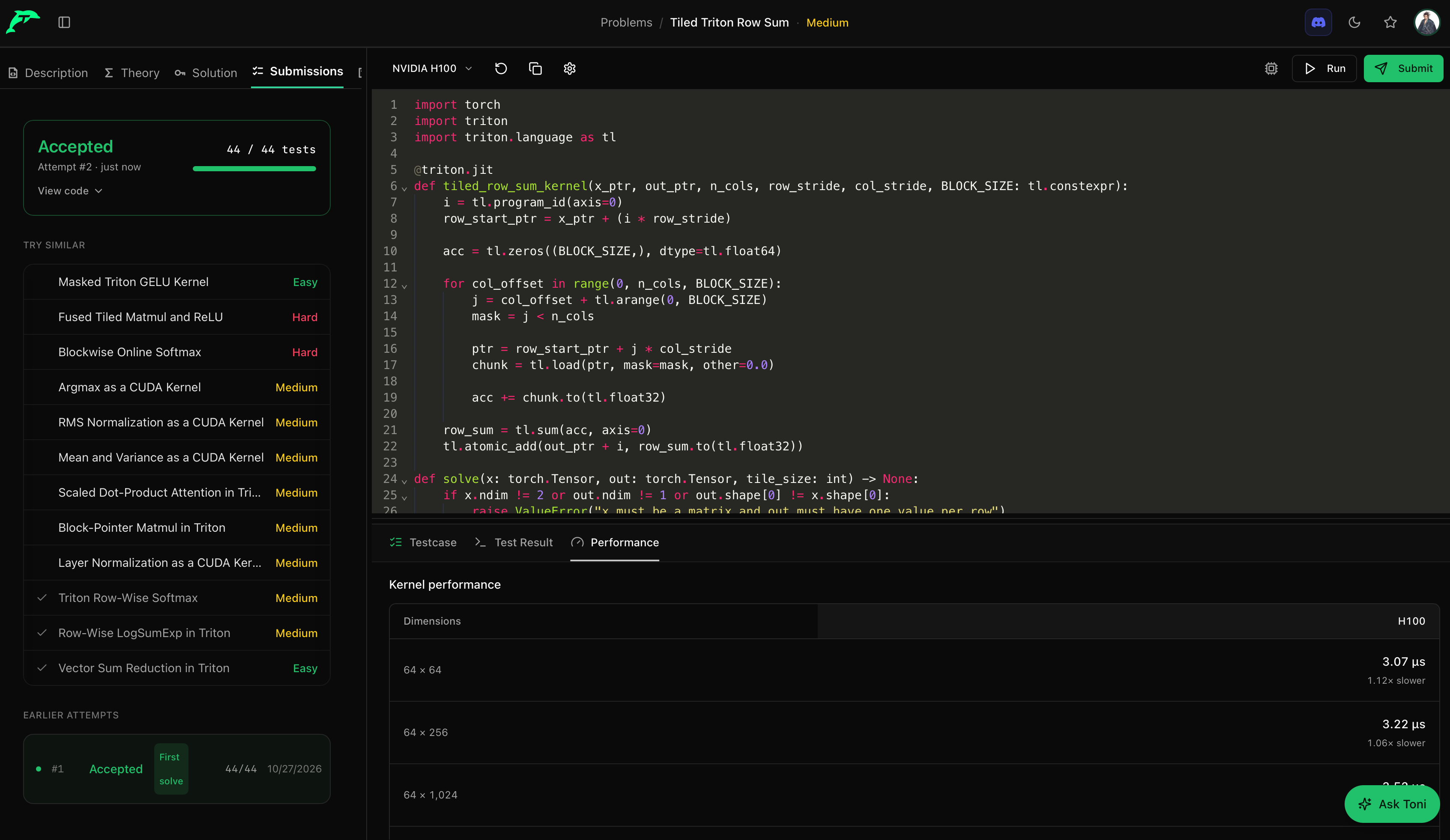 Figure 4: Passing 44/44 tests on NVIDIA H100 with the atomic kernel on TensorTonic
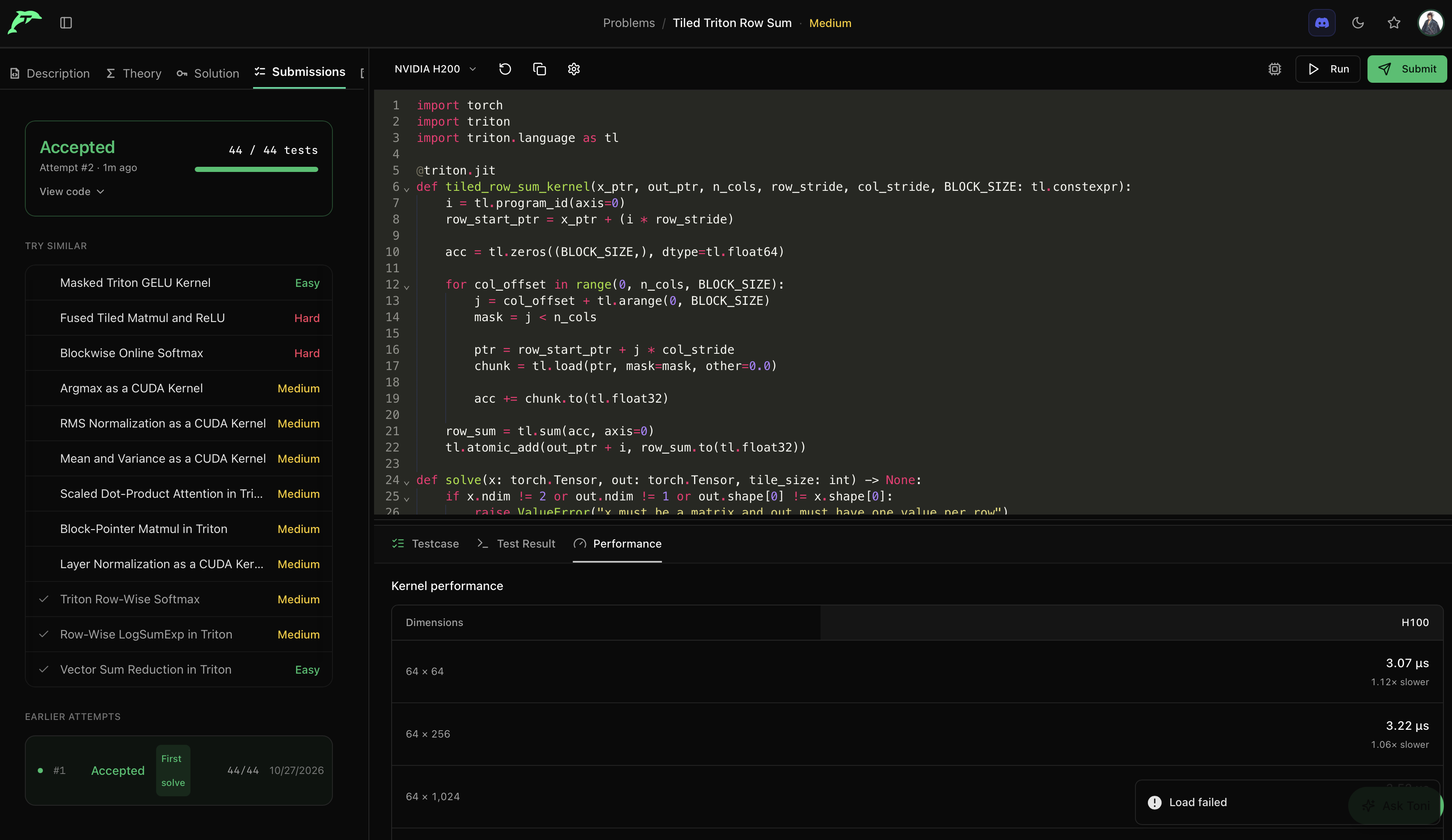 Figure 5: Passing 44/44 tests on NVIDIA H200 with the atomic kernel on TensorTonic
I did not make note of the latencies but I suppose it would be relatively the same, considering the same hardware family. If you guys are very nit picky, I suggest running it directly on TensorTonic and
So the atomic versions work. I would still prefer the original kernel for this problem, for two reasons, one of which matters much more for Fix 2 than for Fix 1.
1. Atomics accumulate onto whatever is already in out
tl.storeoverwrites whatever bits were left in uninitialized memory.tl.atomic_addperforms a Read-Modify-Write: it reads the existing value, adds your result to it, and writes it back.
The pre-filled run shows exactly this. Both atomic versions returned every row offset by the garbage value, while the baseline did not care. On LeetCode-style platforms like TensorTonic, the host harness plausibly allocates the output with torch.empty(R, dtype=torch.float32). I have not checked that harness, but it is a common pattern. An atomic version of the solution would have to zero out before launching the kernel (for example with out.zero_()), and the baseline needs no such step.
2. Hardware: register shuffles vs. L2 atomics
Look at where the data lives at the end of the loop:
- In our working code, all
BLOCK_SIZEpartial sums are already in the SM’s Register File. tl.sum(acc, axis=0)reduces them with warp butterfly shuffles (shfl.sync.bfly.b32): shuffle steps, with threads exchanging data register-to-register and no memory traffic. A single scalar write (tl.store) then goes to Global Memory.tl.atomic_addinstead sends updates out of the SM, through the interconnect, to the L2 cache’s atomic units, which serialize competing updates to the same address (in Fix 2, all lanes of a row target the same address). I have not measured how much of this the hardware merges, but either way it turns an on-chip reduction into a round trip across the memory system.
This concern applies mostly to Fix 2, which issues one atomic per lane. Fix 1 issues one atomic per row, to a different address for every row, so I would expect little contention. I have not benchmarked any of the versions against each other, so this reason rests on how the hardware works, not on a measurement.
For this problem, then, the honest case for the baseline is simplicity: it needs no atomics and does not depend on out being zeroed. Fix 1 is a perfectly reasonable pattern, and it is exactly what you want when several programs contribute to one output element (see the table in the takeaway). Here a single program owns the whole row, so there is nothing to combine.
Would the Behavior Change on Different GPUs?
A natural question: would this behavior change on different hardware? I first hit the error on an enterprise NVIDIA H200 (Hopper, sm_90a). I have since reproduced it on a free Colab NVIDIA T4 (Turing, sm_75, Triton 3.6.0). What about a consumer NVIDIA GeForce RTX 5090 (Blackwell, sm_120)?
My prediction was that it would not change at all, and on the T4 that held: the same RuntimeError, with the same tt.atomic_rmw (scalar pointer, vector value) in the dump, for both test shapes and for both float32 and float64 accumulators. In the float32 version there is no arith.truncf at all, which confirms that the f64 in the original dump was a red herring. The RTX 5090 and AMD remain untested, so for those this is still reasoning, not a measurement.
The compilation angle
Triton’s compilation pipeline is split into stages:
The failure happens in the second stage, the Triton-dialect MLIR. The verifier runs on the host CPU and checks whether the operands of "tt.atomic_rmw" satisfy the dialect’s type and shape contracts. A scalar pointer paired with a 1D tensor does not, so compilation aborts. This happens before any target-specific lowering: no register allocation for the GPU, no PTX, no CUDA driver calls. Since an invalid IR is invalid regardless of the target, the T4 result is what I expected, and I would expect the same on an RTX 5090 or even an AMD GPU through Triton’s ROCm backend. I have no credits to test AMD, unfortunately.
The microarchitectural angle
Suppose we make the kernel compile by splatting the pointer, as in the previous section. Would the hardware story differ across generations? Across all three GPUs—from 2018 Turing to Blackwell—the relevant hierarchy is the same:
- Registers are local to the SM. A butterfly shuffle never leaves the execution pipeline.
- Atomics leave the SM. Whether the memory behind L2 is GDDR6, HBM3e, or GDDR7, an atomic update must travel to the L2 slice that owns the address, where it is serialized against competing updates.
The memory technology changes the bandwidth numbers (roughly 320 GB/s for the T4’s GDDR6 versus about 4.8 TB/s for the H200’s HBM3e), but not which side of the SM boundary the reduction happens on. Register shuffles stay the cheaper option on every generation.
The Takeaway and the Final Fix
The rule of thumb for reductions in Triton comes down to scope:
| Scope | Reduction Mechanism | Correct Primitive |
|---|---|---|
| Intra-CTA reduction (combining lanes inside a single thread block / tile) | Keep data on-chip: warp shuffles, plus shared memory when the block spans multiple warps | tl.sum(acc, axis=0) + tl.store(out_ptr + row_idx, row_sum) |
| Inter-CTA reduction (combining partial sums across different CTAs, which cannot see each other’s registers) | Reduce to a scalar inside each CTA first, then atomically accumulate across blocks | tl.atomic_add(out_ptr + row_idx, block_scalar) (scalar pointer + scalar value; the output must be zero-initialized) |
For this kernel, where one CTA owns a whole row, stick to the intra-CTA pattern: reduce the accumulator on-chip with tl.sum(acc, axis=0), then tl.store the final scalar. It avoids the MLIR error entirely, it does not depend on out being pre-zeroed (the atomic versions do), and it is the right default whenever a single program owns the whole reduction. Atomics become the right tool only when several programs must contribute to the same output element.
Epilogue
What started as a one-line experiment with a peer ended up peeling back several layers of Triton’s abstraction stack. It is easy to look at Python-based GPU DSLs like Triton and forget that beneath the clean decorator syntax is a multi-stage MLIR compiler checking dialect grammar, shapes, and type invariants. This is the kind of thing I like to do, and I would suggest it to anyone working on similar systems.
I have been writing CUDA C++ for some time, and picked up OCaml about 6 to 7 months ago. Both encourage you to look closely at compile-time and runtime errors, and OCaml, a functional-first language with a very capable compiler, has a lot more to teach.
My experience working on Tesserae and its intermediate representation, Tirix, reinforces the same lesson: a domain-specific compiler’s expressiveness is only as good as the clarity of its verification passes. Here the verifier did its job. It refused an illegal operand combination before anything ran on the GPU. But the message I received, “error encountered during parsing”, was far less helpful than the verdict behind it. For Tesserae, that is a useful reminder: catching bad IR is only half the job, and the diagnostic has to tell the user what went wrong. Understanding where the compiler’s responsibility ends and where the hardware’s memory hierarchy begins is, I think, the real secret to writing performant custom kernels.
This has also fired my enthusiasm to learn MLIR. Before this I had little to no knowledge of MLIR and I had to actually rely on an LLM to understand what this bug is. So this was a great reminder for me as well.
References
- Tillet, P., Kung, H. T., & Cox, D. (2019). Triton: An Intermediate Language and Compiler for Tiled Neural Network Computations. Proceedings of the 3rd ACM SIGPLAN International Workshop on Machine Learning and Programming Languages (MAPL). https://dl.acm.org/doi/10.1145/3315508.3329973
- LLVM / MLIR Documentation. MLIR: Multi-Level Intermediate Representation Overview & Dialect Concepts. https://mlir.llvm.org/
- TensorTonic. Problem 344: Tiled Row Sum. https://www.tensortonic.com/problems/tiled-row-sum
- NVIDIA Corporation. CUDA C++ Programming Guide: Warp Shuffle Functions & Atomic Functions. https://docs.nvidia.com/cuda/cuda-c-programming-guide/
- Triton source code. The
tt.atomic_rmwoperation definition (TritonOps.td) and the atomic type-checking in the Python frontend (semantic.py), both in https://github.com/triton-lang/triton. File locations may have moved between versions.